
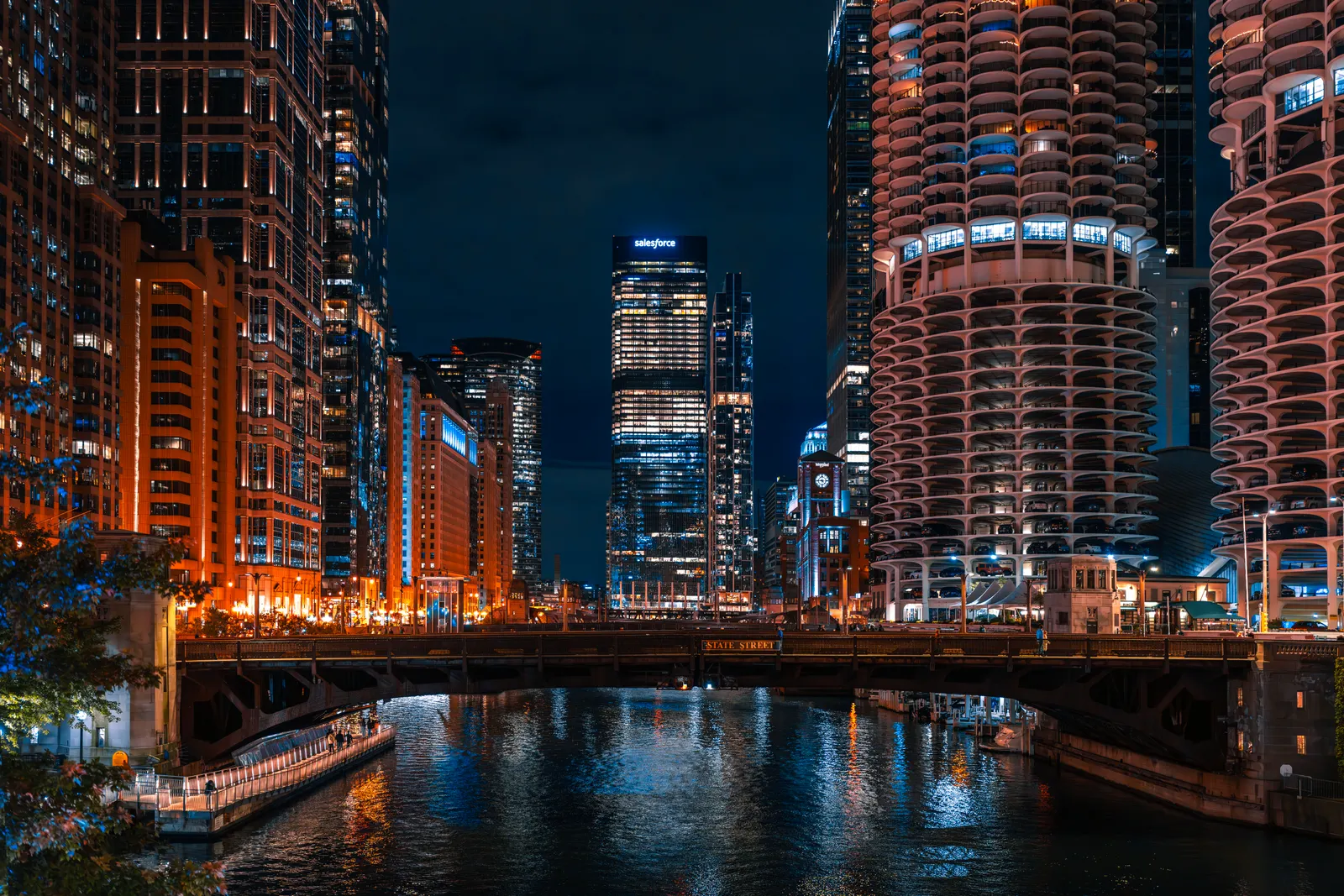
Chicago spends its daylight hours selling architecture — the boat tours, the glass towers, the Mies van der Rohe pilgrimage. After dark it tells the other story, the one that actually built the city: the fires, the disasters, the gangsters, and the ghosts that grew out of all three. It is one of the few American cities honest enough to run tours about its own worst nights.
The river is the spine of it. Almost every dark chapter in Chicago history happened within a few blocks of that water, which makes the night version of a river cruise the best possible introduction.
The river remembers
Most Chicago River cruises narrate the buildings. The night version narrates the body count — and Chicago has a real one. In July 1915 the SS Eastland rolled over at its dock in the river while still tied up, killing 844 passengers and crew before it had gone anywhere. It remains one of the deadliest disasters in the city’s history, and it happened in water you could almost throw a stone across. Four decades earlier the Great Fire of 1871 had leveled the city from roughly the same downtown core.
A night cruise that swaps the architecture tour for dark history works that water after twilight, trading the usual script for disasters, crimes and the ghost stories attached to them — the Eastland, the Fire, the killings — with a bar on board and the skyline supplying all the lighting it needs. The reason to take the night version over the standard daytime architecture float is that it shows you the same river with the other half of its story switched on: you pass the actual Eastland dock and the stretches where the Fire jumped the water, narrated by a guide working from the record rather than a script of building dates, drink in hand, the towers lighting up around you as the sky goes. It manages to be genuinely atmospheric without tipping into cheap theatrics, and it is the single best first move of a Chicago night — the whole dark map laid out from the water before you walk a step of it.
Gangsters and ghosts are the same story here
No American city is more bound to its criminal history than Chicago, and the tours that work treat the gangsters and the hauntings as one continuous tale. On February 14, 1929, seven men were lined up against a garage wall at 2122 North Clark Street and machine-gunned in what became the St. Valentine’s Day Massacre — Capone’s signature, though he was conveniently in Florida. The garage is long gone, but the corner still draws people who feel something off about it.
A walking tour of the Loop’s Prohibition underworld and the ghosts it left behind covers the era’s crime sites and the spirits said to linger at them, grounded in documented history rather than invented spookiness, led by a guide who knows the difference between a verified hit and a story someone made up for tips. On foot you stand on the actual corners — the alley, the hotel lobby, the stretch of sidewalk where it happened — which is the part a window-seat tour can never give you. If you would rather cover more ground, an evening bus tour through Capone-era crime runs between the addresses that made the city infamous — the hits, the rackets, the hideouts — from a seat, so you reach the sites scattered well beyond the Loop that you would never walk to in one evening. The walk for depth and atmosphere; the bus for range and a rest for your feet — the efficient way to see the whole map in one night.
Drink where Prohibition actually happened
Chicago more or less wrote the playbook on the speakeasy, and unlike most cities it still has the originals. When the Eighteenth Amendment shut the bars in 1920, the trade simply went underground — behind unmarked doors, into basements, through the back of pharmacies that did a suspicious amount of “medicinal” whiskey. An adults-only tour through the city’s historic speakeasies, including a bar pouring since the 1800s works through downtown rooms with the history told where it happened rather than printed on a cocktail menu. The pull here is access: you drink inside genuine surviving rooms, one of them serving since the 1800s, with the guide handling the unmarked doors and the order so you are not standing on a sidewalk trying to find an entrance with no sign on it. The city’s most Chicago chapter, in the rooms where it actually played out.
For something rowdier, a costumed, mile-long haunted crawl through Lincoln Park — built partly over the city’s old municipal cemetery, never fully relocated — pairs a guide in 1920s dress with ghost stories between the bars. It is the loud, sociable end of the night: a mile of Lincoln Park covered on foot, three bars with the walks between them filled by a costumed guide working the cemetery history, and a group big enough that nobody drinks alone. The crawl when you want the party with a spine rather than a quiet history walk.
The ghost the whole city believes in
Every great ghost town has one signature spirit, and Chicago’s is Resurrection Mary. The story, told for the better part of a century, runs the same each time: a young woman in a white dance dress, picked up hitchhiking along Archer Avenue after a night at a long-gone ballroom, who asks to be let out at the gates of Resurrection Cemetery and then walks through them and vanishes. Drivers have reported her for decades. It is the kind of legend that survives because enough sober people swear it happened to them, and it tells you something about how seriously this city takes its dead.
The darkness here is not all folklore, though. Chicago gave the country one of its first documented serial killers — H. H. Holmes, who built a so-called “Murder Castle” near the 1893 World’s Fair, a building rigged with sealed rooms and chutes, and used the crowds of visitors as cover. The hotel is gone; a post office stands on the site. But it set a template the city’s dark tours still trace: the idea that Chicago’s grandest moments — the Fair, the building boom, the Jazz Age — always had a body count running underneath them.
That tension is what makes Chicago after dark worth the trip. By day it is the most earnest architecture city in America, proud of its skyline and its engineering. By night it admits the rest: that the same river, the same Loop, the same lakefront were also the scene of the disasters, the killings and the hauntings that the daylight tours politely skip.
How to tell a real Chicago tour from a hayride
Chicago runs more dark tours than almost any American city, and the quality swings hard, so it pays to know the tell before you book. The good ones are specific: a guide who can name the date, the address and the documented outcome — the Eastland on July 24, 1915; the garage at 2122 North Clark; the Fair of 1893 that gave Holmes his cover — is giving you history with a chill. The weak ones lean on “they say” and “people have felt,” because vague is cheaper than researched. If an operator will not tell you which sites you are visiting, that is the answer.
The other thing Chicago does that few cities can is keep the originals. The speakeasy tours drink in rooms that actually ran during Prohibition; the river cruise passes the actual dock; the crawl walks ground that genuinely sits over old burial land. That authenticity is the whole reason to pay a guide here rather than read a plaque — the city still has the physical evidence, and a good guide stands you in front of it. Pick the format to your appetite — cruise for the overview, walk for the depth, bus for the range, crawl for the party — and lean toward the operators who name names. In a city this documented, specificity is not a nice-to-have; it is the difference between a history you will remember and a costume with a flashlight.
How to build the night
Lead with the river cruise while there is still a little light on the towers, then move to a walking tour as the evening settles, and finish in the bars. Chicago weather is the one variable that will wreck a plan — the cruises run seasonally, and the lake wind bites well into spring, so check the forecast and bring a layer you would not pack anywhere else in June. Book the cruises and speakeasy tours ahead; both cap their numbers and sell out on weekends.
Book a tour
Live prices and availability open on each partner site. We may earn a commission, at no extra cost to you.
Each experience links to a vetted booking partner for live times and prices. See the full Chicago after dark guide, or read more in the best night cruises in the USA.