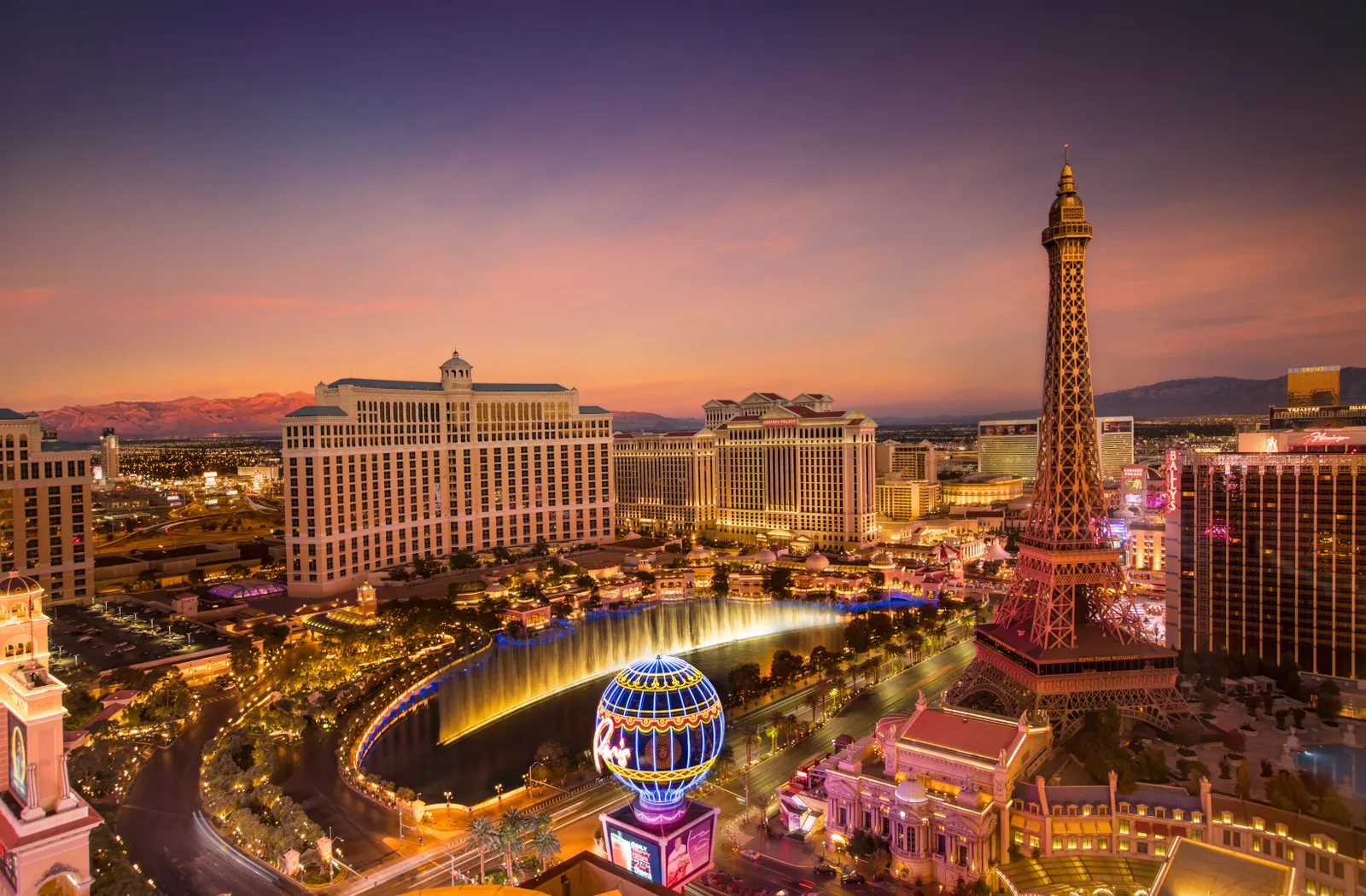


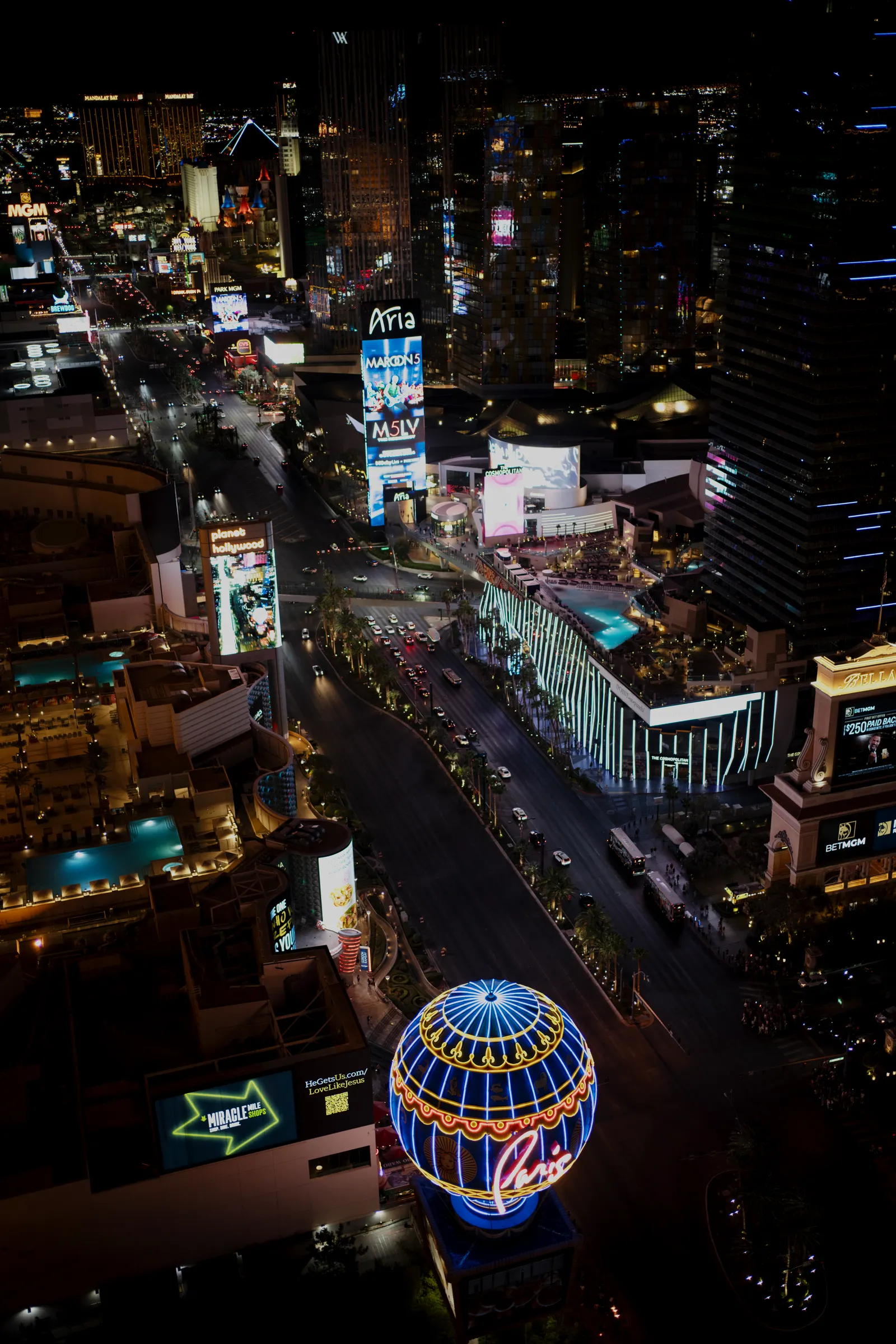
Las Vegas is the only major American city that was built to be seen in the dark. Drive the Strip at noon and you get a row of beige boxes shimmering in 105-degree heat. Come back at 9pm and the same boxes turn into the most expensive light show on earth. The city knows this about itself, which is why almost nothing important here happens before sunset.
The trap most first-timers fall into is treating the night as one long blur of casino floors: no clocks, no windows, free drinks, and a strange amnesia about where the last four hours went. There is a better way to run a Vegas night, and most of it happens with the casino at your back.
Start in the air, not on the floor
Here is the move almost no one makes on night one: get above it. A twelve-minute helicopter flight over the Boulevard does something no walk or rideshare can — it shows you the whole organism at once. The Strip resolves into a single ribbon of light, the Bellagio fountains pulse on cue, the Sphere glows like a dropped moon, and then, abruptly, the grid just stops and the black desert begins. That edge is the thing photos never capture: how small and deliberate this city is, marooned in nothing.
The reason to book this one rather than a daytime canyon flight is the staging. Hotel pickup is included, so there is no rental car and no airport wrangling at the small terminal southeast of the Strip; you are collected, walked to the pad, and back at your hotel inside a couple of hours. The aircraft seat you against the glass, the cabins are quiet enough to talk over the headset, and the route deliberately holds over the Bellagio so the fountains fire while you hang above them. Do it first, while you are fresh and the light is at its best, and the rest of your trip has a map — you will spend the next two nights recognizing the buildings you floated over. Of every splurge in this city, it is the one that pays you back on every later night rather than just the hour you bought.
The history the casinos would rather you skipped
Behind the wattage is a city built by people who settled disputes with shovels in the desert. The mob did not just visit Las Vegas; it poured the foundations. Bugsy Siegel took two bullets through a Beverly Hills window in June 1947, about six months after opening the Flamingo, and within the hour his partners were standing in the casino telling the pit bosses they were in charge now. Tony Spilotro, the inspiration for Joe Pesci in Casino, ran a crew that the FBI called the Hole in the Wall Gang. The bodies that turned up in the desert were a cost of doing business.
A guided night walk through the mob history and hauntings under the neon turns the marketing inside out, tracing the hits, the disappearances, and the performers who, by many accounts, never quite left their old showrooms. The guides work from the documented record — the Flamingo’s bloody opening, the skim that built half the Strip, the careers that ended in car trunks — and tell it on the actual ground where it happened, which is the part the casino museums leave out. It runs on foot in a small group rather than a coach, so the stories land at conversational distance, and the whole thing comes in well under the price of a Strip show. It is half true crime, half ghost story, and entirely more interesting than another hour at the tables — and you will not look at the Boulevard the same way on the walk back.
If you want it more hands-on, there is a version that hands you the equipment. A small-group ghost hunt with EMF meters in tow puts real gear in your hands — the meters and readers the guide explains as you go — and visits the rooms with reputations: old haunts tied to Elvis, Liberace and a few spots locals still avoid. The group is kept deliberately small so everyone gets a turn with the equipment rather than watching a guide wave it around, and the guide keeps the comedy turned up while the gear does its thing. Equal parts investigation and stand-up, and a far better story to bring home than a blackjack loss.
Where Vegas actually drinks
The megaclubs on the Strip are a tax on tourists: forty-dollar cover, eighteen-dollar beer, and a bottle-service economy designed to separate you from your weekend. The locals are not there. They are downtown, on and around Fremont Street, where the bars are older, weirder, and roughly a quarter of the price.
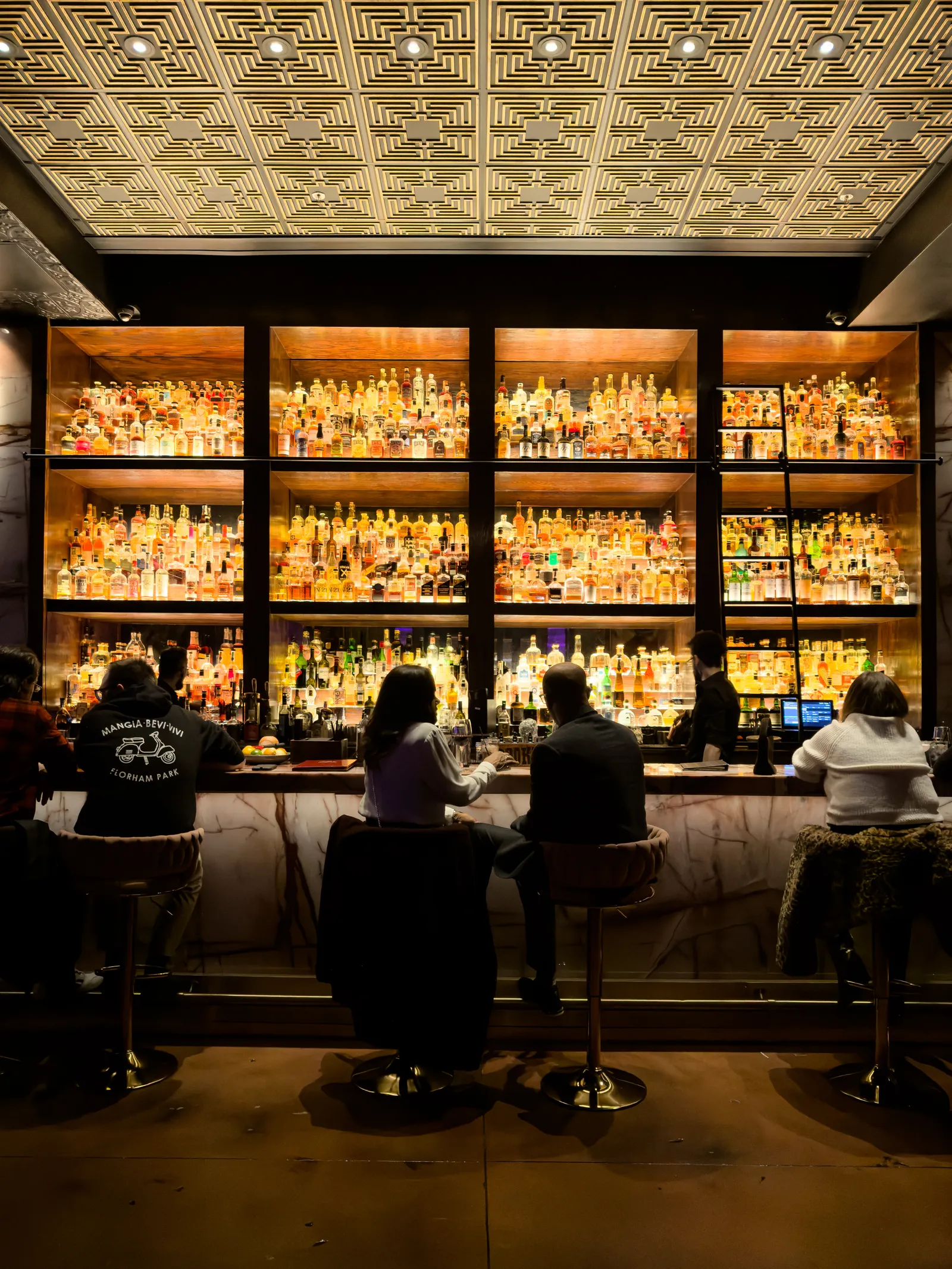
This is the original Vegas — the neon cowboy, the low ceilings, the dive bars that have outlived three corporate reinventions of the Strip. A guided crawl through three downtown bars where residents actually drink gets you in with no cover, a line-skip at each stop, and a drink deal waiting, which means you spend the night drinking instead of negotiating with doormen. The route is the real value: a local guide has already sorted the bars that survive on regulars from the ones surviving on tourists, and walks you between them in the order that works, so a stranger to the city lands straight in the rooms it would take three nights to find alone. The group does the rest — by the second bar a couple or a solo traveler has people to drink with. Old Vegas energy, a fraction of the Strip tab.
The other Vegas, after midnight
The Strip is the headline, but the strange, good stuff happens at its edges and in its small hours. The Neon Museum keeps a boneyard of dead signs — the original Stardust, Moulin Rouge and Sahara letters laid out under the open desert sky — and seeing them after dark is closer to visiting a graveyard than a museum, which is exactly the point. A few blocks east, the Arts District has quietly become where Vegas creatives actually drink, in low-slung bars that would not survive a week on the Boulevard. And the whole city runs on a 24-hour clock that takes some adjusting to: 3am here feels like 11pm anywhere else, the diners are full, and last call is mostly theoretical.
That round-the-clock rhythm is the thing visitors underestimate. The move is not to fight it but to lean in — eat late, start late, and accept that the best hour on the Strip is often the one most people sleep through. Around 1am the bachelorette crowds thin, the fountains keep firing for almost no one, and the city briefly belongs to whoever is still paying attention. A lot of the guided ghost walks and downtown crawls are built around exactly those late slots, when the stories land harder and the bars have room to breathe.
One thing the brochures skip entirely: Vegas is a desert, and the desert is the real attraction once the carpet stops impressing you. Stand on a high floor at 2am and look past the Boulevard to where the lights simply stop — that black nothing starting at the city’s edge — and you get the same vertigo the helicopter gives you. A tiny, brilliant, deeply improbable city, switched on in the middle of nowhere, running all night for its own amusement.
The best of the Strip is free — most people just pay around it
For all the talk of bottle service and forty-dollar covers, the Strip’s signature spectacles cost nothing, and the visitors who blow their budget tend to walk straight past them on the way to a club. The Bellagio fountains run every fifteen to thirty minutes after dark, several hundred jets choreographed to a rotating soundtrack, and the best vantage is the free public sidewalk on Las Vegas Boulevard rather than any table you can pay for. The Mirage volcano, the canal singers at the Venetian, the dancing-light shows the resorts stage on their own facades — all of it is engineered to pull foot traffic past the casino doors, which means it is free to anyone willing to stand on the pavement and watch.
The trick is to treat the Strip as an open-air attraction first and a casino floor second. Walk the east side from roughly the Cosmopolitan up to the Venetian and you pass most of the headline shows in under an hour, no ticket, no cover, the whole boulevard performing for you. Do that early, before the crowds thicken, then point the actual spending at the things that are genuinely worth it — the flight, the downtown bars, a tour with a guide who knows the city’s underside. The fastest way to overpay in Vegas is to mistake the free spectacle for the thing you have to buy your way into.
How to actually plan the night
The winning Vegas night has range, not volume. Go up first while you are fresh and the light is best. Walk the dark history in the early evening, when the Strip is lit but the crowds have not yet thickened. Save the drinking for downtown and late, when Fremont hits its stride. If you only have one night and want the quieter, more historical version, start with the downtown ghosts-of-old-Vegas walk instead of a casino.
Two rules keep the night from collapsing: hydrate like it is a sport, because the desert will quietly dehydrate you faster than the cocktails will, and book the timed experiences — helicopters, guided tours — in advance, because the good slots sell out and walk-up pricing punishes you.
Plan the night
Live prices and availability open on each partner site. We may earn a commission, at no extra cost to you.
Every experience here links to a vetted booking partner where you confirm live times and prices. Start with the full Las Vegas after dark guide for the complete list, or compare it head to head with the coast in Las Vegas vs Miami after dark.