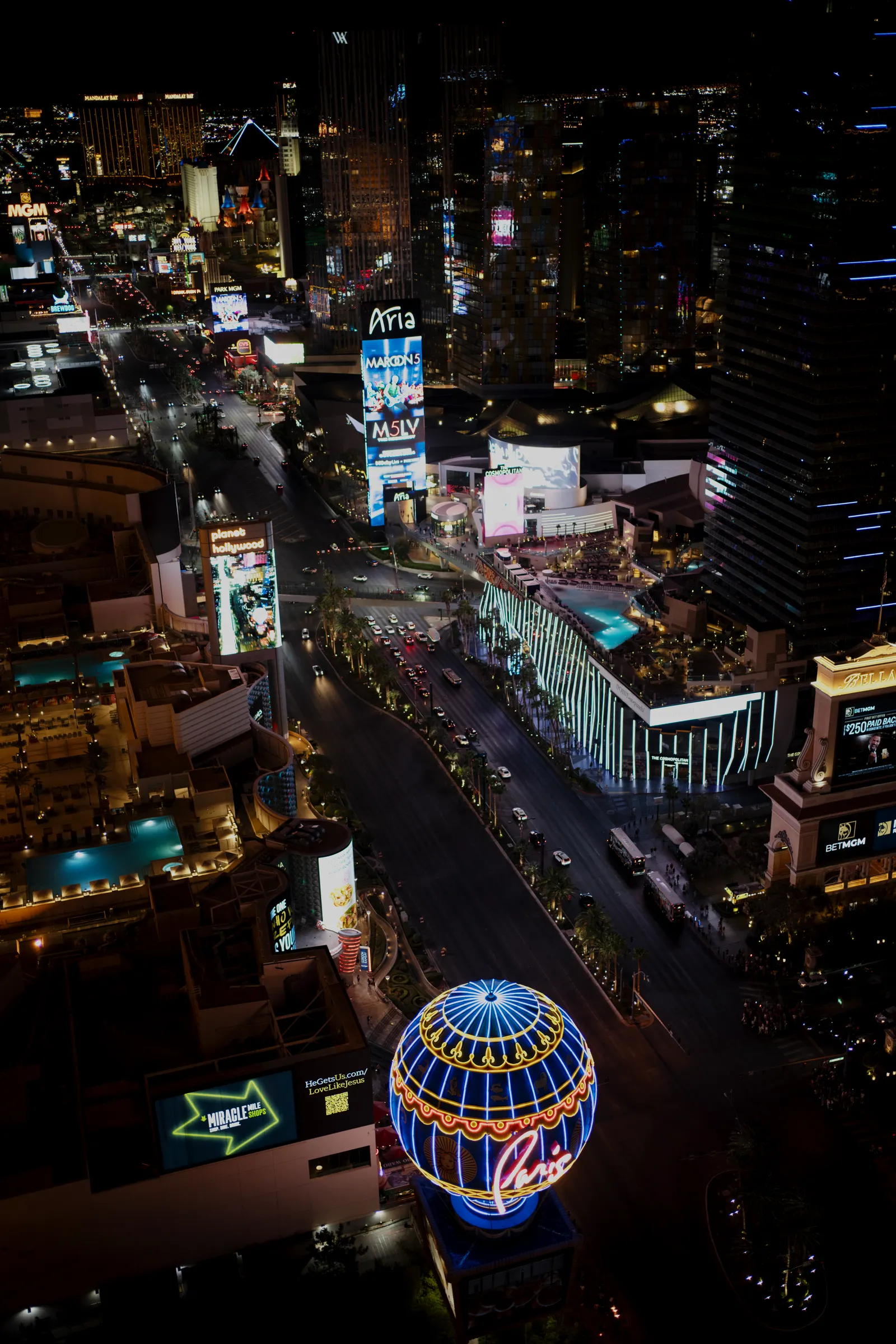



Las Vegas and Miami are the two American cities that take the night most seriously, and they could not disagree more about how to spend it. Vegas builds its night indoors and upward, around a single glowing Boulevard engineered to keep you inside. Miami pushes its night outdoors and outward, onto the water and the sand, where the city is the backdrop rather than the building you’re trapped in.
Pick wrong and you’ll spend the trip fighting the city’s nature. Here’s how to choose the one that matches the night you actually want.
The case for Las Vegas: spectacle and density
Vegas wins on sheer engineered spectacle. Everything is within walking distance of one Strip, the production values are gloriously absurd, and the after-dark range is wider than its party-town reputation suggests. You can be in a helicopter over the Bellagio fountains at nine and a downtown dive bar by midnight, and never touch a casino floor if you don’t want to. The underrated part is how much of the spectacle is free: the Bellagio fountains, the resort light shows and the canal singers all run on the public sidewalk, staged to pull foot traffic, which means a thin budget still buys a remarkable night if you point the actual spending at the few things worth it. And the whole machine runs on a 24-hour clock, indoors and weatherproof, so a Vegas night never depends on the forecast — the single biggest practical edge it holds over Miami.
The single best thing you can do in Vegas is also one of its least obvious — go up. A twelve-minute night helicopter flight over the Strip, hotel transfers included resolves the whole city into one ribbon of light marooned in black desert, with the route holding over the Bellagio so the fountains fire beneath you. Hotel pickup is built in, so there is no car and no terminal wrangling — you are collected, flown, and back inside a couple of hours. It is the view that makes the whole place make sense, and unlike anything Miami offers, it reframes the rest of the trip.
For the authentic local night, skip the Strip megaclubs and crawl the downtown Fremont Street bars, no cover and line-skip at each, where residents actually drink. A local guide has already sorted the rooms that survive on regulars from the ones surviving on tourists and walks you between them with no cover and a line-skip at each — old Vegas, a quarter of the Strip price, and the cheap-and-cheerful night Miami struggles to match.
Vegas also has a surprisingly good dark side. A Strip ghosts-and-hauntings walk through the mob history buried under the neon is the genre’s least expected entry — a small-group walk that traces the real mob history, the hits and the disappearances, on the ground where it happened, for well under the cost of a Strip show. A quieter, stranger night, and a welcome break from the noise.
The case for Miami: weather and water
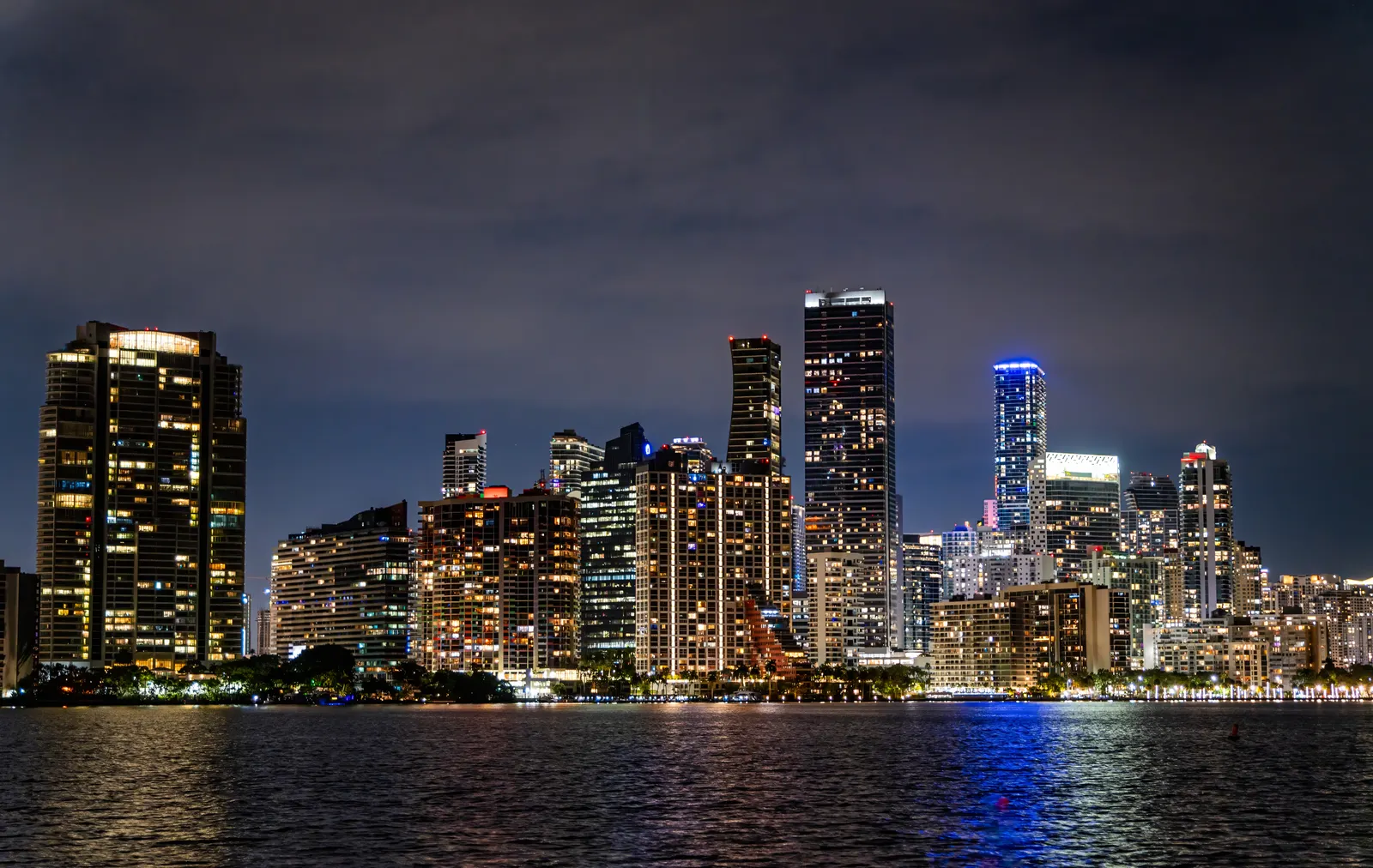
Miami wins on everything Vegas physically cannot offer: an ocean, a real beach inside the city, and a night that happens under open sky. The crowd is more international, the temperature after dark is a feature rather than a furnace, and the main event is Biscayne Bay. An adults-only bay party cruise with a DJ, a dance floor and two drinks sends the skyline sliding past, two cocktails and the deck included and a 21-plus crowd there to go out — the club night Vegas sells, except outdoors and afloat, with no cover and no cab between venues because the boat is the venue.
Miami’s history runs darker than its tan, too. A haunted pub crawl through the Deco bars of South Beach threads four bars from Lummus Park toward Ocean Drive, sea air and cocktails laced with stories of mobsters and murder and the route already sorted — proof the prettiest strip in Florida has a colder past, and the rare crawl with an ocean breeze in it.
And for the full Miami sequence, a boat-party-to-nightclub package, boat first and VIP club entry second does the handoff — drinks on the water, then straight past the line onto land. Club entry is the hardest, priciest part of a Miami night to arrange cold, and this skips it on prepaid VIP entry. The complete Miami night in one ticket, and the closest thing the city has to a sure thing.
The practical differences that actually decide it
Beyond vibe, four things separate these nights in ways that matter to your plan. Cost: Vegas has a wider floor and ceiling — you can have a great cheap night downtown or hemorrhage money at a Strip club, your call. Miami runs expensive more uniformly; the bay, the boats and South Beach door fees add up, and there is less of a cheap-and-cheerful fallback. Getting around: Vegas is walkable along the Strip and a short rideshare downtown, so a carless night is easy. Miami is spread across the Beach, the bay, Wynwood and Little Havana, and you will be in rideshares between them; budget for it.
The crowd: Vegas is built for the visitor — bachelor and bachelorette parties, conventions, people there specifically to go out. Miami mixes a heavier local and international scene into the tourism, which makes it feel less packaged but also harder to crack without a plan or a guide. The season: this is the big one. Vegas is a reliable machine year-round, brutal heat in July notwithstanding, because so much of the night is engineered and indoors. Miami lives and dies by the calendar — sublime from November through April, a humid endurance test at the height of summer, and exposed to hurricane season’s weather swings from roughly August on.
One last distinction: what you do with a hangover. Vegas offers a spa, a pool and a buffet, and expects you back out by nine. Miami offers a beach, an ocean and a café con leche, and the recovery is half the appeal. If the daytime matters as much as the night, that tilts the decision more than any club ever will.
Two different kinds of night, not two grades of the same one
The trap is treating this as “which city parties harder.” They party differently, and the better question is which version you actually enjoy. Vegas is a contained, vertical, indoor night: the spectacle is engineered and stacked along one Boulevard, the air-conditioning never quits, and the city is designed to keep you moving between rooms without ever needing the sky. It rewards people who like density and decision-free logistics — everything is close, everything is open, and the weather is irrelevant. The flip side is that it can feel sealed off, a night that happens inside a machine built to hold you.
Miami is the opposite shape: horizontal, outdoor, scattered. The night lives on the water and the sand and across four or five neighbourhoods that each keep their own hours, and the warm open air is the whole mood. It rewards people who would rather feel a breeze than a carpet, and who do not mind a rideshare between scenes as the price of variety. The cost is friction — more planning, more distance, more reliance on the calendar and the weather behaving. Neither is the better night in the abstract; they are answers to different questions. Want to be inside one glowing machine with everything in reach? Vegas. Want the city and the water around you, open to the sky? Miami. Decide that and the rest of the choice makes itself.
The verdict
Choose Las Vegas if you want maximum spectacle with minimum logistics — one Strip, everything walkable, a night that runs on adrenaline and neon and doesn’t depend on the weather. Choose Miami if your ideal night involves a deck, a breeze and a skyline rather than a casino floor, and you’d rather the city be around you than above you.
The honest tiebreaker is the calendar. Vegas is a reliable year-round machine; Miami is transcendent from late fall through spring and a humid endurance test at the height of summer. If you’re booking for July, Vegas. For January, Miami, no contest.
Book the night
Live prices and availability open on each partner site. We may earn a commission, at no extra cost to you.
Both cities’ experiences link to vetted booking partners for live times and prices. Go deeper with the full Las Vegas and Miami after-dark guides.